Some uncanny Thing guarded the tomb of the dead Pharaoh—but Lord Cairns was impetuous and unafraid. He learned too late the secret of the mummy!
Did a weird doom follow the scientists who broke into the tomb of Tutankhamen?
Everyone has heard rumors—but do you know the truth?
Here is the "inside" story of an ill-fated attempt to rifle the grave of another Pharaoh. Names are disguised for obvious reasons but the narrative is based on facts.
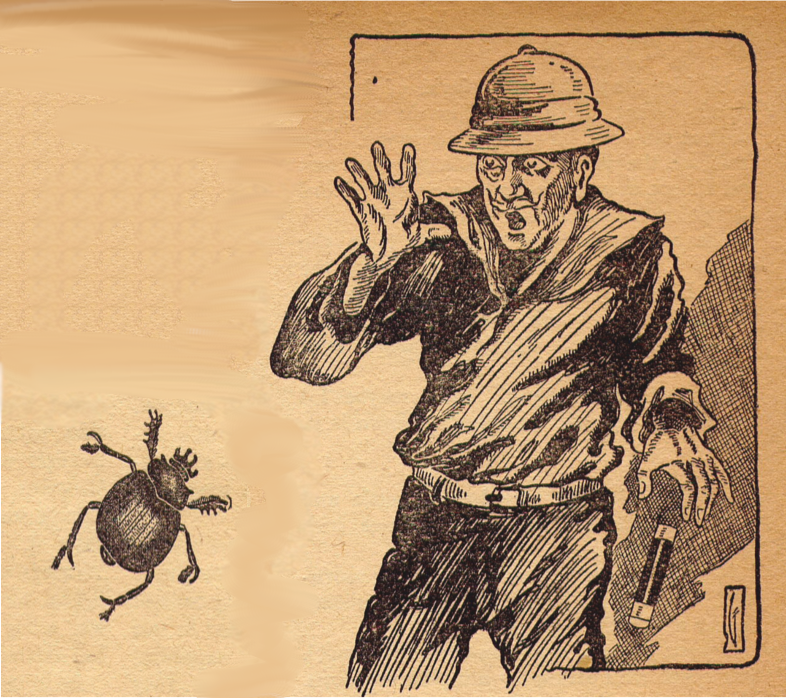
LORD CAIRNS leaped back from the broken masonry of the tomb and slapped savagely at his left hand. Something fell to the ground and then scuttled away into the rocks. He made a wry face and scrutinized his wrist.
"The bloody little beggar—he bit me!"
The professor and I came closer. "What was it?" I asked.
"A beetle, a scarab beetle, young fella-me-lad. They've always been thick as flies in this country. In the old days the Pharaohs used to hold them sacred and wear rings in their likeness. You've seen the stones? Very likely the old chappie in there"—he motioned toward the passageway that led down into the tomb—"very likely he's wearing scarab rings all over his fingers."
As he spoke, a shiver ran over me. I could picture the ancient mummy of the buried king, covered with jewels and ornaments in the likeness of insects—for a moment I could almost see them moving weirdly.
"Scarabeus Sacer," pronounced the professor, looking hopefully into the crevice where the beetle had hidden. "It was a rare sort, too. Did either of you notice the odd golden streaks on its back? Some people say that this particular beetle carries the cartouche, or signature, of the Pharaoh Amenophis on his back."
"But aren't you going to do anything for it?" I asked Lord Cairns. He laughed and shook his head. "Aren't they poisonous or anything?" The two little bluish wounds on his wrist affected me strangely.
"They're harmless," he told me. "It's your first day here, young fella, or you'd have probably been bitten by several yourself. The rocks are full of the nasty little blighters. They pinch when they're frightened, that's all."
It might be well to explain how I happened at this time to be so far from New York and my job on an afternoon newspaper. Only a few weeks before, I had received a call from Professor Roswell Beames, an old friend of my father's. I had thought the professor was buried in his beloved Ancient Languages at the University of Chicago, but it turned out that he had been asked to go to Egypt and take part in the anticipated opening of the newest tomb discovered in the Valley of the Kings.
He wanted to take me with him as a sort of assistant. The dear old man was writing one of his everlasting books, and it was his plan that I should aid in keeping his notes and arranging things for him. The magic of Lord Cairns' name had secured me a temporary leave-of-absence from my job, and we had arrived in Egypt twelve days later.
There were four of us in that little party encamped above the tombs of the long-dead Egyptian kings, for Lord Cairns was accompanied by his niece, who acted as his secretary—Janet was her name. Then there were a couple of native house-servants who took care of our tents, and the score of native fellaheen, who had been working for months along the cliff wall in an endeavor to find for Lord Cairns the tomb he hoped to open there.
It was nearly dark when Lord Cairns was bitten by the beetle, and so we decided to call work off for the day. There was still a great deal of rock that must be moved before we could dare to go down the sloping passageway which we could see in the dim light of our electric torches, and the native workmen were growing restless.
The professor and I had arrived only that afternoon and had stopped at the camp just long enough to deposit our belongings. But that had been time enough for me to decide that Janet Moore, the niece and secretary of our leader, was one of the most charming girls I had ever seen. Then the impatient professor had dragged me away in the direction of the excavating, leaving Janet smiling at us from beneath the double awning of the main tent.
That evening it did not take me long to become acquainted with Janet. Lord Cairns and the professor had been together in excavating before and Janet and I were dependent on each other for entertainment.
"I'm glad you've come," she told me. "I get so tired of hearing nothing but tombs and mummies and dead things. Uncle has but one idea, and that is to exhume some peaceful Pharaoh." She shivered a little. "Do you know, I think it's ghoulish the way he tries to ferret out the poor dead Pharaohs. He would think it terrible if anyone went into the cemetery at home and started to dig up his ancestors."
"But that's different," I put in. "This is a scientific investigation——"
"Maybe for the professor. But not for Uncle. He just does it for the thrill, I think." She pointed to the native tents, below us on the slope. "I understand some Arabic, and the natives frighten me with the things they say. They prophesy that the first one to enter the tomb will die. If it had not been a dry season, not one of them would go on working, but they must take what they can get, or starve. The Nile did not rise much this spring."
Together we went into the tent, where Lord Cairns and the professor were making plans for the opening of the tomb.
"It will take about two weeks," estimated Lord Cairns, "before the natives can get the rocks cleared away so we can get down the passage."
"And then," put in the professor with a gleam in his eye, "then we'll know for sure whose tomb it is. If it's the tomb of Amenophis——"
"Who is Amenophis?" I asked. My knowledge of Egyptology was confined to what I had read in press reports.
"Amenophis was the greatest king in the history of Egypt—or, at least, the most interesting.
The pharoah referred to here as Amenophis is Akhenaten, originally known as Amenhotep IV / Amenophis IV. Akhenaten established the possibly monotheistic religion Atenism: the worship of Aten, the sun, which did not flourish past his reign. Nefertiti was his principal wife, but probably not his only one. For he founded the first known religion to have one god, and one alone. Some scholars say he wrote two of the Psalms that appear in the Bible today.
There are some apparent similarities between Akhenaten's Great Hymn to the Aten and Psalm 104. The exact nature of the relationship between them (if any) is under debate. And he had but one wife, Nefertiti, who was the most beautiful woman Egypt ever produced. A statue of her was found last summer in the tomb of Ay and Thi, her parents. If this is the tomb of her husband that we are opening, it is probable that we will discover a wealth of jewels and artistic objects beyond anything ever collected in one room before——"
THE professor was interrupted by the sudden entrance of Bulo, our cook. He came directly to Lord Cairns, without knocking at the entrance.
"House-boy and me no like. We go tonight away from this valley. We want silver pay." He seemed sullen, yet frightened.
"Nonsense, Bulo. What's the matter? Anything go wrong?" Lord Cairns smiled, but I knew him well enough already to see that he was inwardly furious.
"Go wrong?" Bulo laughed bitterly. "Anything go wrong? Huh! All the day nothing but beetles. Beetles in the tent. Beetles in the kitchen. Beetles running across the floor. We no like beetles. They bring bad luck. We no like being near tombs. No good. We want silver pay, yes?"
"A big chap like you afraid of beetles, Bulo? What harm can they do to you? Look at me one bit me this afternoon. You can't see the mark. Get back to your tent and I'll see that you get a coin extra." Lord Cairns held out his wrist to the cook.
The man shuddered and ran from the room. Even from where I stood, across the table, I could see that the two spots where the beetle had pinched Lord Cairns had turned bright red! He looked down with surprise.
"Superstitious beggar. Still, maybe I'd best be putting iodine on this. Where is it, Janet?"
SHE got him the tiny brown bottle and helped him dab the bright redness with the antiseptic.
"We'll send for new servants in the morning," he decided. "They are always quitting in fear of the Valley."
I went to my mosquito-curtained couch that night with strangely mingled emotions. I was not at all sure what sort of a place I had stumbled into. For a long time I lay awake, staring at the canvas roof of the tent above me. There was an atmosphere of something impending—something which weighted down my chest and made it hard to breathe, though the night was cool.
When I fell asleep, my dreams were all of phantom beetles that turned into finger rings, and of bejeweled mummies that came walking out of opened tombs, gesturing to me to go away. And all through these dreams ran the thought of Janet, like a silver thread. I saw her in the tomb as the wife of the Pharoah, and wearing the scarab rings, and I saw her, too, warning me to go away from that place of doom.
Next morning all was bustle and hurry again. A messenger procured us more servants—a villainous-looking crew who assured us that they feared neither man nor ghost. I was a little reluctant to leave Janet alone, but Lord Cairns told me that she carried a revolver and knew how to use it.
"She's a rare girl, young fella-me-lad, and it's the lucky man who'll marry her." He grinned at me. "Be sure you spend no more time over your typewriter than is necessary, for I'd hate to have her feel neglected here."
The work of removing the débris from above the tomb went on—with deadly slowness, it seemed to me. The natives moved leisurely and with obvious reluctance, and it was easy to see that if it had not been for their evident necessity, not one would have gone near the tomb for any amount of money.
It was a gloomy enough place, for all the brilliant sunshine that poured into it for nearly twelve hours a day. From eleven in the morning until three in the afternoon not even the natives could stand to work in the sun. During that time we would take naps in the shade of our awnings, or drink cool liquids prepared by Janet, who was as capable as she was beautiful.
Janet and I soon became the best of friends, for the similarity of our ages and our interests drew us together. During the long twilight every evening we would take long walks together, while her uncle and the professor made plans and discussed technical matters. I came to care very greatly for this slim English girl whose calm brown eyes met mine so firmly.
And sometimes we sat outside the tent, and listened to the others as they argued over the fine points of Egyptian history—sat hand in hand, whispering of things less dead than Pharaohs and tombs.
"I'm worried about Uncle's wrist—where the beetle bit him," she said to me one evening. "It doesn't seem to heal up as it should. He says that it doesn't bother him, and that it doesn't hurt, but why does it stay so red and inflamed? He won't let me do anything for it."
I had thought Lord Cairns had recovered from the tiny wound, and I was surprised to find him still marked by it.
"He told me the beetles weren't poisonous," I said.
"Then perhaps it's the climate—this hot dryness has a peculiar effect on everything. Such dreams I've had since we've been here—dreams of beetles and things—I imagined that they warned me away. Of course it's all foolishness."
I wondered, for I had had the same dreams. And, though I did not ask, I imagined by the look in her eyes that I had figured in her dreams even as she in mine.
WE were walking down through the Valley of the Tombs of the Kings, as it has come to be called because of the many successful excavations carried on there since 1900. By day it is a dry, hot oven but in the cool moonlight we found it wonderfully pleasant.
Hand in hand, we walked down the pathway that wound among the loose boulders. When we came to a rock that towered above all the others, we scrambled up and surveyed the whole Valley as if from a throne.
Far behind us we could see the tents of our party gleaming in the white moonlight, and the yellow glow of the kerosene lamps shone through them dimly. The professor and Lord Cairns were still talking.
Ahead of us, though we had not noticed it, was the tomb entrance, just underneath the cliff, which overhung it to some degree. We could see the heaps of loose rock and rubble which the men had succeeded in removing from the mouth of the tomb, and the framework of scantlings which had been built around one side of it. Behind the tomb was the dark cliff, thrown into intense shadow. Above this, the full moon stared at us until I could hardly keep from remembering the old superstition about people who go to sleep in the light of the moon—that they are moon-touched, and go mad.
Suddenly Janet caught my arm. She pointed to the tomb. At first, blinded by moonlight, I could see nothing in that obscurity. Then—I can never be sure whether I saw or imagined it—I seemed to see something huge and dark moving up out of it—moving up the vertical wall of the cliff! It was round, or nearly so, and on its back I imagined that I saw faint, phosphorescent gleamings.
Janet's fingers gripped my arm until it was numb. "What can it be?" she whispered quaveringly. "Do you see it, dear?"
A nameless feeling of dread came over me, and I knew then that nothing tangible, nothing real, was crawling up that side of the cliff above the tomb.
"I must go and see what it is," I told her. "Will you wait here?"
"Please——"
"It's nothing, dear. You and I have been staring at the moon too long, that's all."
But I did not believe it, and she sensed that I was talking to reassure her. "Don't go far. Please!"
I slipped down the side of the rock and made my way toward the cliff. I could still see, or imagine, at least, the wavering Thing on the vertical side of the cliff—and yet I knew that no living thing could find footing there.
As I got a little closer to the tomb, I stopped and rubbed my eyes. There was nothing on the side of the cliff! From top to bottom, now that I was in the shadow, I could see it stretch out lonely and bare. I turned to retrace my steps.
Just at that moment a scream came from behind me. Trying to focus my scattered nerves, I raced back across the stones to Janet. She was holding one hand to her lips.
"I'm sorry," she said. "It's nothing at all to make such a fuss about. Something ran across my arm, and when I moved—it bit me!" She showed me the two tiny red marks that I somehow knew would be there.
"Your uncle said that the rocks are alive with beetles, and that we'd all get bitten before we are through here." I spoke in as casual a tone as possible but I was far from feeling sure of the ordinariness of everything. The fear of the natives, Bulo's evident terror of the beetles, and the weird dreams we both had had, to say nothing of the beetle-like thing that we had seen crawling up the cliff, conspired to make me wonder and fear.
I wrapped my handkerchief about her hand and wrist and made her promise to use antiseptics on the wound as soon as we could get back to the tent. Both she and I were aware of a deeper significance in all this, but each tried to reassure the other, and we came back to the tent pretending that we had imagined the Thing on the cliff. But the two red dots on Janet's hand were not imagined.
The time came, a few days later, when the last of the loose rocks had been removed from above the entrance to the tomb, and we could dare to think of going down that passageway on the morrow.
PROFESSOR BEAMES was jubilant. "I shall have wonders—positive wonders—to send to the Field Museum. If this is the last resting place of Amenophis, it will be the greatest find in the history of archeology. Whether it is his or another's, it will be of the greatest value to science. We shall be famous in every capital of the world, my friends, when we send the news out to Cairo." He spent the evening in preparing note-books and cameras, in order to be ready to make records of everything that happened.
Lord Cairns seemed in the grip of a terrible excitement. The sunny Englishman of my first few days was gone, and in his place was a nervous, intense person who spoke seldom, clipping his words short and avoiding company when he could. The professor was so engrossed in his own plans and hopes that he did not notice, but Janet and I felt that something almost inhuman had come over her uncle.
"Ever since the beetle bit him, in the tomb entrance," she told me, "Uncle has been changed, somehow."
"And his wound hasn't healed yet, though yours is quite gone." I pointed to the place on her hand where the beetle had pinched. The two dots had almost disappeared. Lord Cairns had taken to wearing a glove over his hand, and he had resented any mention of it on the part of Janet or myself.
To me there seemed something inhuman about the man and his fierce thirst for excitement. He struck me as being the sort of person who would, as a boy, tie firecrackers to a dog's tail—not from any particular cruelty, but from a careless desire for noise and excitement. There was something ghoulish, I thought, in the relentless way he had spent most of his life ferreting out the long-buried kings and queens of bygone ages and gloating over their poor treasures and their little secrets.
He spent the evening pacing back and forth in the main tent, seemingly oblivious of everyone. Janet and I sat outside beneath the awning. She had promised, that night, to be my wife when our work in the Valley was over. Much as she wanted to tell her uncle, he seemed in such a nervous and preoccupied mood that we dared not. And the dear old professor would simply nod and smile at us, and then go on with his enthusiastic preparation for the morrow.
It was late in the afternoon next day before we were ready to open the thin brick wall that sealed the passageway. The native workmen were in as great a state of nervousness as Lord Cairns himself, but he drove them mercilessly.
Janet sat on a rock near us, waiting for the great moment, although she had lost most of her enthusiasm, as had I. But her uncle and the professor were as excited as children on a holiday.
Finally the staccato blows of a pick pushed through the wall and the bricks fell inward.
With the impetuousness of youth I rushed to the hole—but a dash of foul air bore me back choking.
Lord Cairns shook his head. "Not so fast, young fella-me-lad. That air is three thousand years old."
We waited, for a few minutes. Finally Lord Cairns made a ball of crumpled newspaper and lit it on one corner. Then he dropped it into the narrow hole. It fell a few feet, then bounced down sideways, till it was out of sight. But it did not go out.
"It's healthy now," he announced. He was not altogether right, if he had known.
Professor Beames was busy making a diagram of the mouth of the tomb entrance. Lord Cairns and I prepared to enter the sepulcher. I must confess that at the time I had no thought but that of gaining insight into the wonders that might lie beneath us. The lure of the unknown, and of buried treasure, is strong in all of us. Janet's face turned white as I started to lower myself into the dark hole, but I waved to her and went on in after Lord Cairns.
CLOSE at my heels was the professor. "I must see it, too," he gasped, as he scrambled down.
There was a platform about six feet down and then a flight of steps. Lord Cairns was ahead, sweeping the walls with his flashlight.
"Careful," warned the professor. "We must not disturb. Everything is of the greatest scientific value. A breath may destroy——" His voice sounded deep and booming in that narrow passage.
Step by step, we went down into the earth. I counted fifteen before we were brought up, in a sudden sharp turn, before a door.
So far, the walls had been barren of any inscription which might tell the names and rank of the person buried here.
"Hurried funeral," decided the professor aloud. "The royal personage died young, before his tomb was complete."
But the door was sealed with a great seal. Lord Cairns pushed at it impatiently, but the professor thrust him aside, burning with eagerness.
While we watched, he cast himself on his knees before the great seal and blew away the thick dust which was over it. By the light of his electric torch he hurriedly deciphered the characters of the royal cartouche. He turned to us, smiling with realized ambition.
"It is the tomb of the Pharaoh Amenophis!" he said. "It is the greatest discovery in modern history. And the seal has never been broken—the interior must still remain untouched!"
Lord Cairns clasped our hands in eagerness. "Come on—on to the interior!"
But the professor shook his head. He pointed to the elaborate wax seal, ornate with gold and paint, and bearing a long inscription.
"We cannot break this until it is copied and photographed," he told us, as one might speak to a very young child. "The tomb and its contents have waited three thousand years and more. They will wait a little longer."
Suddenly the insignificant little professor had taken complete command of the affair. He seemed to take on new stature and an added gravity, For the science which he had made a part of him was so much greater than our personal selfishnesses that Lord Cairns and I both gave way.
"IT will take only a few days to make complete copies and photographs," the professor mused. "Perhaps I can cut around it and preserve the seal itself intact. It has always been found broken before, in other tombs."
I had somewhat naively hoped that the tomb and its secrets were to be immediately opened to us. I slowly climbed back to the surface, leaving the professor and Lord Cairns before the inner door.
As soon as I was above the surface, Janet caught me in her arms. "My dear," she said—"I was afraid that you would never come out." She shivered, though it was stifling hot. "I have a feeling sometimes that we should all run away from this valley—before some frightful calamity befalls us."
I smiled at her fears, and told her of the passageway and of the great seal which the professor was so interested in keeping intact. Together we walked slowly back toward the tents. It was growing dusk and no more could be done that evening.
Our camp was situated on a little rise of ground about a half mile from the excavation where we had met success. Here Janet and I waited for Lord Cairns and the professor. We could see the little hushed group of workmen far to the west of us, standing dark against the yellow rock.
SUDDENLY I noticed that the natives were coming rapidly toward the camp in an excited group. Behind them were the professor and Lord Cairns.
In a few minutes they were all about, jabbering and gesturing excitedly. It seeme that they totally refused to work any longer at any price whatsoever; each demanded his wages immediately, so that they might get far away before nightfall. Lord Cairns made no effort to keep them, but gave each man his silver pieces and a farewell kick.
"Disgustin' blighters," he remarked. "Always frightened, these natives."
"What are they frightened of?" I asked.
"Spooks, of course. They say, as far as I can make out, that the first person to open a tomb gets all the vengeance of the corpse. And they have no intention of waitin' for the fireworks."
The men had set off at a quick trot, still chattering excitedly like monkeys. Behind them raced two donkeys led by scared little brown boys bearing their few belongings.
As they passed over the cliff top, I saw one of them stop and bow twice almost to the ground—in the direction of the excavation we had made. For a moment I was awe-stricken at sight of his obeisance to a king three thousand years dead. I remembered that, according to Egyptian philosophy, the dead wander about through eternity, or at least until the Judgment, and that they inhabit, while it remains, the body that was theirs while living. And if this body is lost or destroyed, the dead wander lost and homeless forever. When we went inside the tent we all started talking excitedly of the find we had made, and of its possibilities. Only Janet was silent, and after a few minutes of speculation about the value of our discovery I took her hand and we walked out under the awning.
"I can't explain," she said, "but I have a strange premonition that you—that all of us are in danger. I hate this valley, and I hate what we are doing here. It has changed my uncle so I hardly know him. I don't see why he is so set upon dragging out the musty bones of some poor dead Pharaoh."
For some time we discussed these things. I did not tell her of the moment when I had seen the departing fellah bow to the tomb we were to open. In such moments it is the part of men to smile and reassure the opposite sex—to be superior and confident. But I felt very much as she did, now that the thrill of discovering the tomb was past.
INSIDE the tent the professor and Lord Cairns were still arguing about the opening of the tomb's inner door.
"It must not be done before the seal is removed and studied. Once broken, it will be lost to us, for the wax is very old. Why hurry so, my friend? The tomb has waited three thousand years——"
Lord Cairns did not reply, but long after Janet had gone to her tent and the professor had climbed into his hammock, I saw him sitting at his table, staring out into the white night. His eyes seemed glazed and he appeared to be under some sort of a spell. His whole being was tense with excitement.
I watched him covertly from behind my curtain. Suddenly I saw him push back his camp-chair and rise. He walked over toward me, and I feigned sleep, for I did not want him to know that I had been spying. For a moment he stood over me, listening to my breathing. My heart beat so loudly that I thought he might hear it.
Evidently assured that I was sound asleep, he turned away. Taking a flashlight and a revolver from the table drawer, Lord Cairns raised the curtain of the tent and passed outside.
My first thought was that he intended to stand guard over our discovery, which was a very wise plan, indeed, since so many natives knew that we had been lucky. I crossed silently to the doorway and parted the canvas a crack. Lord Cairns was in the cook tent and I could hear him rattling the tool chest. In a moment he reappeared with a great hatchet which the native cook used for cutting meat.
Without looking in my direction he walked swiftly toward the tomb across the Valley.
For a second I did not know what to do. I thought of awakening the professor, but then, after all, Lord Cairns was paying the expenses of the expedition and our permit to excavate was in his name. If he wanted to open the tomb, it was his business.
But the man seemed under great nervous excitement. Hesitating no longer, I slipped into my corduroy trousers and boots, and with an electric torch in my hip pocket I set off after him. The moonlight shone bright as day and so I kept close in the shadow of the cliffs. Lord Cairns was far ahead of me, walking swiftly. Over the boulders he climbed, with never a backward look. He was making a bee-line for the tomb of Amenophis.
The necessity for my keeping out of sight in case he should turn, kept me near the cliffs, where the going was harder. At times I had to use the torch to pick my path and once I fell headlong across a big stone and lay for a moment with the breath knocked out of me. So he gained on me as he neared his goal, and when I arrived at the mouth of the tomb he was well inside and had already removed the barrier that he and the professor had put up in the afternoon.
I crept to the gaping mouth of the passageway and looked within. Far below I could see the glow of Lord Cairns' torch against the blackness. Then came the sharp sound of blows. He was crashing the hatchet against the inner door of the tomb!
In the afternoon, when we were all excited by our success, I had sympathized with Lord Cairns when the professor refused to allow him to destroy the seal. But now, in the cold moonlight, it seemed to be a betrayal for him to hack his way alone into the tomb. After all, our only excuse to open the place at all was a scientific one, and if the remains of the ancient civilization were to be ruthlessly destroyed, we were no better than the natives who had robbed so many of these tombs in the past.
THE monotonous beat of the hatchet in Lord Cairn's hands still resounded from the passageway. Leaning farther over the edge, I tried to see if he were destroying the wax seal or cutting around it.
But in leaning over, I had the ill-fortune to dislodge a small stone from the rubbish around the hole and it bounded down the passageway with a series of sharp crashes. The sound of the hatchet ceased.
I drew back, afraid that Lord Cairns would take a shot in the darkness. But in a moment his sharp face stuck out of the hole. "Oh, it's you?" He smiled genially. "Grab one of the picks there and give a hand, young fella-me-lad. We're goin' to wait for no deciphering. The tomb has never been opened, and I'm goin' to be the first!" He motioned toward the camp. "Professor wouldn't believe that I could get the seal off without ruining it. Watch me. I thought I'd make it easier for him by handing it to him at the breakfast table. No argument then, y'know."
There seemed nothing else to do but take up the tool and follow him into the excavation. After all, it was his expedition. He had paid for the pick in my hand—even for the boots and trousers which I was wearing.
I CLIMBED into the gloomy tomb entrance, carrying the pick. Lord Cairns had propped the flashlight on the ground, slanted upward so that it cast light on the seal. I saw that he was cutting through the soft sandstone around its edges, and trying as he had said, to keep it intact for the professor.
Together we worked for a few minutes. A thick, choking dust filled the narrow passageway and breathing was almost impossible. We tied handkerchiefs across our mouths and worked on.
I was chipping away with the pick, on my side of the door, as carefully as I could. But things were moving too slowly for my impatient companion. He thrust the hatchet in my hand and took the pick.
"Stand back," he said. "We're almost through. When this piece is out, the rest will be easy."
With all his strength he swung the heavy pick against the door. At the third stroke I could see through the swirling dust that the rock was almost ready to fall. Then, with the point of the pick, he caught and pried it out. The great seal and the rock to which it had been affixed fell outward, breaking squarely across the middle.
He turned toward me, ruefully. "The professor was right, after all, my lad." Then he caught his hand to his mouth, choking. From the narrow hole in the door came a rush of the foulest air I have ever breathed. It was musty with the scent of long-dead things. It was pollution, decay and corruption, and all the worse because of the sickeningly sweet odor of mouldy spices.
Together we climbed into the air again and waited.
"Let's go back to camp," I suggested. "The air will clear out by morning."
For some inexplicable reason I did not wish to return to that dark doorway again. He shook his head. "I'm going through with it. The air will soon clear. And I—you and I—will be the first to enter the tomb chamber."
I have proved many times in my life that I am no coward. I would face man or beast with my head held high, if it were necessary. But I shivered as I looked back into that dismal hole.
Real bravery would have been to have walked back to camp at that moment. But I was afraid to leave Lord Cairns, afraid to have him think me a coward. So I swung my heels in the excavation and wished that I were anywhere else.
After perhaps a half hour of waiting we returned to the doorway. I made a crumpled ball of paper, but Lord Cairns refused to allow me to light it and cast it into the tomb.
"The place is full of dry, decayed wood and cloth. A match might destroy everything—and choke us with smoke before we could get out. We'll have to take a chance on the quality of the air."
With the tools we soon succeeded in prying out enough of the loosely plastered blocks of sandstone to permit our entrance. I carefully picked up the two pieces of stone that had held the seal and carried them out into the open. The seal was still complete and could be put together if the work were carefully done. Hardly any of the colored wax had come away, since it was bound with gold leaf.
When I returned, Lord Cairns was dragging out the last of the stones that made the door. Perspiration was pouring from his forehead, but he was smiling.
"We're almost there," he whispered. Excitement made him as tense as a coiled spring. "We'll soon have a look at this chappie, Amenophis."
HE wiped his forehead, and motioned me to follow him. The air no longer was particularly offensive. I bade a mental farewell to Janet and stepped after Lord Cairns into the tomb.
Our flashlights hardly helped to illumine the darkness of that place. Around us were piled vague heaps of blackness, which might have been royal furniture in some bygone day. Most of the wood had crumbled to a thick dust at our feet.
Here and there was the glittering of jewels reflecting the light of our torches. There was still the sickly sweet odor of spices in the air, almost enough to choke us.
The ceiling was very low and decorated, like the walls, with painted carvings. Our flashlights traveled swiftly over it, on to the far end of the tomb. On the floor next to the wall lay a great, dark mass which I suddenly knew to be the sarcophagus of the long-dead king. Around it was the shining alabaster of the canopic jars, which are supposed to hold the vital organs of the dead.
It was on a raised platform of stone. More than that, I could not see, for the utter blackness of the chamber choked off the feeble glimmer of our torches and cast weird shadows slanting away from us.
Lord Cairns spoke first. "Well...young fella-me-lad, we're here!"
I NODDED, feeling weak. I didn't want to be there. Anywhere in the world would have been preferable, if only it were in the clean outdoors. His voice boomed through the tomb and echoed shatteringly. A silence three thousand years old breaks terribly.
Lord Cairns moved around like a bewildered and delighted child before a Christmas tree. Everything that the light touched made him exclaim with wonder. There were great crumbling pieces of furniture, carved like animals. There were small jewel caskets, rotted and spilling their princely treasures on the thick dust of the floor. I followed him, still in the direction of the black sarcophagus, or coffin-case, that lay on the platform. A strange foreboding gripped my heart like an icy hand, but I did not turn back. Lord Cairns seemed so sure of himself, so much in command of the situation.
We stood together on the low platform. The outer sarcophagus was of carved gray stone, with a heavy lid. It must have been eight feet long by three feet wide, and the top was far more than one man could handle.
Without speaking, Lord Cairns motioned me to take one end of the stone. He grasped the other. But as my hands touched the mouldering stone, I drew them suddenly back as if I had touched a serpent. The stone was burning hot to the touch!
Lord Cairns looked at me in amazement. "Hurry on, young lad. Let's get a look in."
I touched the stone again and this time my scattered senses found it no otherwise than any stone should be. Together we slid it over and down on the side where it crashed gently on the platform.
I shall never forget the sight that was revealed to me then. The inner casket had been made, as was the custom, in the likeness of the man who was to occupy it. For a moment I thought that a human figure lay there and then I saw that it was cleverly painted wood and cloth wrapping. The face was that of a young man, singularly handsome and commanding. This was the sort of man who could have started a new religion and written two of the Psalms, as historians say that Amenophis did.
I instinctively leaned forward, as if to touch the thing and assure myself of its reality. But as my hand hovered over it, I heard a faint scream ringing in my ears. It seemed to come from an infinite distance, but I knew it to be the voice of Janet! I paused but a moment to look at Lord Cairns. He had heard nothing and was gloating over the richness of the casket.
"Ted!" came the sound of Janet's voice again. "Ted!"
I turned and ran toward the entrance. There had been fear, and imminent danger, in the sound of that dear voice.
Lord Cairns looked up in surprise. "Hi! Where y' going?"
But I did not pause to explain. His hand was poised over the richly painted casket which contained the mummied body of Amenophis—his eyebrows were raised in an almost comic surprise. I shall always remember him so, for it was the last time I ever saw him.
Just as I came into the open air, which was dim with the ghostly white light of dawn, there came a horrible choking sound from the tomb behind me!
I heard the confused jumble of many voices speaking in an alien tongue—and at the same time choking gasps from a throat I knew to be Lord Cairns. I stopped, paralyzed. I knew there was no living human near, except myself and Lord Cairns!
THE gasping screams continued for moment. Shudderingly, they died down to a thin, eerie whisper—and then silence.
I could not help but return to my companion after that. Though my mind was reeling, I dragged myself back down the steps of the tomb. I stopped at the doorway, my blood congealing in my veins.
Across the open sarcophagus lay the twisted body of Lord Cairns. I knew without thinking that he was not only dead—but worse than dead. Around him, in the little circle that my flashlight made, moved strange, vague figure—enormous, shining beetles...great human figures with the heads of beasts, figures that resembled the ancient statues of the Egyptian gods...and, in the center of the uncanny group, the misty figure of a tall, kingly man, wearing the robes of a Pharaoh!
All this I glimpsed in a flash, for I dropped the flashlight and turned to leap up the steps.
Just as I was nearly at the top, a thundering reverberation echoed behind me. The walls bowed out and fell around me with a great shattering of stone. Thick dust was everywhere. I fell partly out of the entrance hole, exhausted. Behind me the tomb and passageway was a mass of débris. There, to this day, lies the body of rash Lord Cairns, together with the body of the Pharaoh Amenophis. Strange bedfellows...the ghoul and the dead...the hunter and the hunted.
BRUISED and shaken, I made my way back towards the camp. Soon Janet came running towards me in the early morning sunshine. Her strong young arms were around me and she was helping me along.
"What happened?" she was saying. "I had the most terrible dream... I saw you in fearful danger and could do nothing. I woke up screaming and trying to hold you back."
I told her part of what had happened, and how her voice had come to me as a warning across the Valley in the vault of death. But only to the professor did I tell the whole story of the Things that I had seen above the broken body of Lord Cairns.
Wakened out of sound sleep, he was unable at first to understand what I meant, but the blood and my torn clothing convinced him soon that something unusual had happened, and in a few moments the old man was up. We went back together to the excavation. In the broad light of day there was nothing out of the ordinary there, except that the cliff had collapsed into the sunken tomb and that the passageway was buried under tons of rocks. Any attempt to enter the tomb through the passageway was impossible now.
There, where I had carefully placed it, was the great seal of Amenophis, broken across the middle. So the professor got his seal after all, although it was the only one of the tomb's treasures that he or anyone else has yet gained. Patched together, it lies today in one of the nation's great museums as an example of hieroglyphic design.
Reports were given to Lord Cairns' family in London that he had perished in a fall of rock—which was enough of the truth.
Professor Beames left the Valley of the Kings sorrowfully, both because of the loss of his friend and because of the temporary failure of his great work. But I understand that he returned last fall to the Valley, to take up once more the work on which he has set his heart, and to try to find another entrance to the tomb of Amenophis. It will take more than a year to lay bare the surface above the tomb, for modern excavating methods are impossible and the fellaheen are slow. But the work goes on, for science will not be denied.
Except for our natural feeling of sorrow at the passing of Lord Cairns, Janet and I were happier to leave that barren spot than anything else in the world. Nothing could have made us remain for even a day in that place af horrors.
We were married shortly after in the offices of the American consulate at Cairo. Since then we have lived quietly and happily here in New York, with no hint on the part of either of us of longing for more adventure, though Professor Beames suggested that we might care to join him when the tomb is opened again.
Janet has been a wonderful wife to me. Never once have we quarreled. But I think that if we ever did, the memory would return to me of the night when her voice came through the distance to save me from a terrible death. I shall remember always the hour when her love proved stronger than the powers of this world or the next.
If our souls had not been in complete harmony that night, I should have placed my hand on the wrappings of the sleeping Pharaoh, and I should have quickly lost my reason and my, life as poor Lord Cairns lost his. And in what strange world is he today?
Part of the series The Supernatural Writings of Stuart Palmer.
Annotations by Nina Zumel.
Image remixed from illustrations for "The Red Curse of the Mummy," Ghost Stories, February 1929.