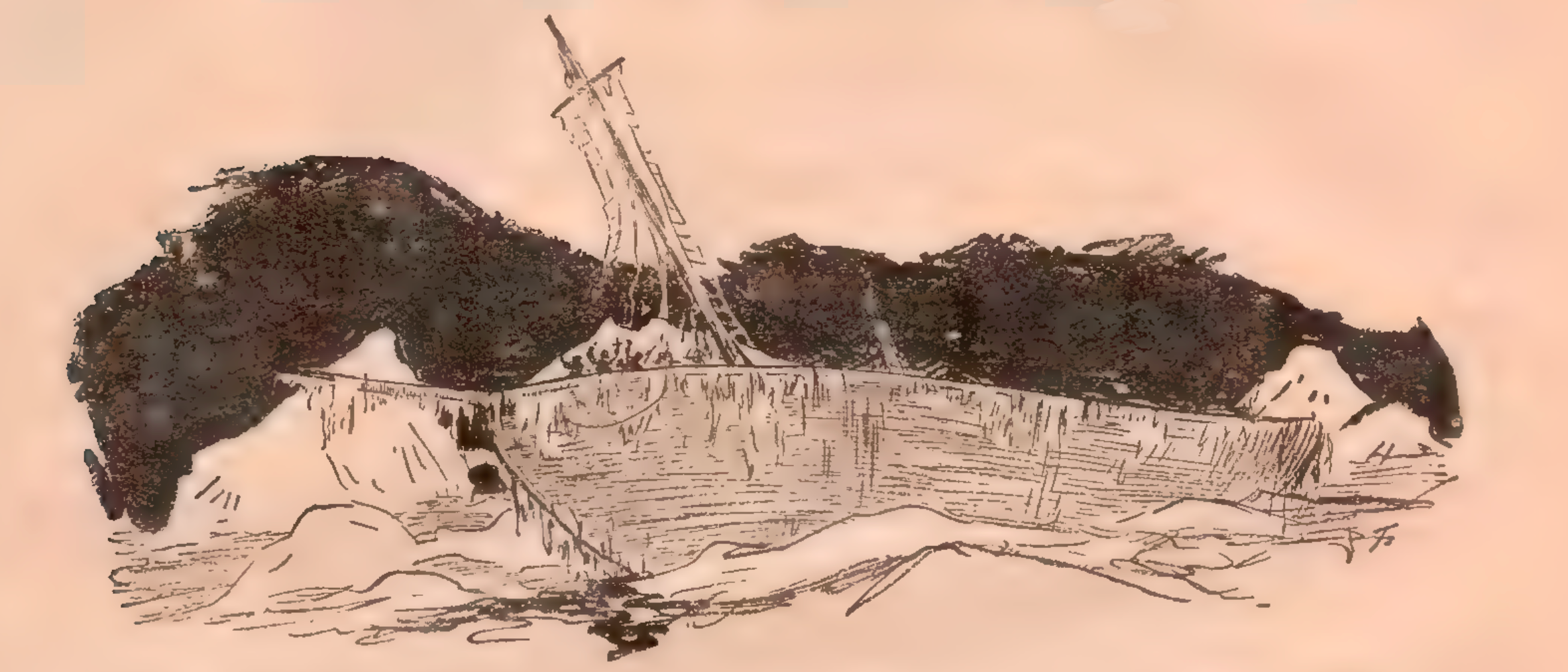
"Steer to the nor'west!" the weird message said. And Captain Bartlett obeyed, guiding his ship toward—WHAT?
Note: This is a true story—and can be proved to the satisfaction of any reader of Ghost Stories. First Mate Robert Bruce, "Scotland's great hero" probably refers to Robert the Bruce, King of Scots from 1306-1329. He led Scotland during the First War of Scottish Independence against England. The story's original source doesn't claim that the First Mate is a "direct descendant." who figures in this strange narrative, was a direct descendant of Scotland's great hero. The actual names of the persons involved are used throughout the story.
FIRST MATE ROBERT BRUCE, of the barque Judith, came rushing up on deck. His expression was strange, and Captain Bartlett stared in amazement at the normally sedate Scotchman who faced him, unable to speak.
"Calm yourself, Mr, Bruce," ordered Bartlett. "What is the matter?"
Bruce found his voice. "There's a strange laddie in your cabin," he whispered. "A strange laddie with burning eyes...."
"Nonsense!" The captain shook his first officer by the shoulder. "You've been drinking, Mr. Bruce."
"I have not, sir, I saw him, plain as day." The two men moved to the rail, out of earshot of the curious crew, who sensed something unusual in Bruce's manner, Bartlett motioned him to proceed.
"I went below," began the mate, "as soon as we had shot the sun at noon. I could have sworn that you went down with me, although I didn't look up for a while. I was busy at my desk with the calculations for perhaps twenty minutes, and then I stopped writing on the slate. I was surprised to find that our bearings were off—that the dead reckoning and the sun didn't agree by fifty knots or so. And so I called to you, asking how your figures had come out."
"But I wasn't there," said the captain.
"I know that—now. But it looked like you, at your desk across the campanionway in the cabin. So I repeated my question, and then the figure raised its head. It had been writing on the slate, but when I spoke the second time it gave me a look that I'll never forget—and that's all. I jumped out into the companionway and came up here." Bruce's face was ashen as he finished.
Bartlett was beginning to wonder, in spite of himself.
"We'll soon settle the matter," he said. And the two of them made for the cabin.
They stopped in the door.
"The room is empty," said Bartlett. "You must have. been day-dreaming."
"No, sir, I was not," insisted Bruce, "I saw him, and he was plain as day. It was the face of a thin sort of laddie, with black hair and eyes that burned into me like gimlets."
"If he was writing on the slate, it'll still be there," said Bartlett, and he walked over to the table.
HE held up the slate to the light, and both men read clearly four scrawled words that wound and twisted themselves on the black surface in a strange handwriting, "STEER TO THE NOR'WEST." That was all.
The captain's manner changed. "Mr. Bruce, will you write those words on a piece of paper for me?"
Bruce complied, but his handwriting was unmistakably different from that of the message. The captain's face grew increasingly serious. He had abandoned all idea that this was a hoax or dream on the part of his first mate.
"Mr. Bruce, call every man on deck. Bring them here one at a time, and have them write those four words on a slip of paper."
The captain took a seat in the corner of the room, and from that vantage point scrutinized every member of the crew as he was brought down. The men were surprised, and whispered among themselves at the strangeness of the order, but Bartlett could detect no signs of guilt on the part of any of them. And when the various slips of paper were brought before him, not one of them tallied in any degree with the writing on the slate.
Three of the crew were unable to write, but each of them had made his mark. Yet the strange handwriting was still unidentified!
"Then there must be a stowaway aboard this ship," concluded the captain, and immediately ordered a complete turning-out of the vessel. Even her lazarette and her hold were to be gone through.
First mate Bruce gave the orders, but shook his head doubtfully.
"How could there be a stowaway aboard," he asked,"when we're nearly six weeks out of Liverpool? We're due to make St. John's in a few days.... If the stowaway had kept quiet this long, he'd have stayed under cover. Besides, how could a man hide food and water with him for so long a trip?"
But the captain was determined.
"It's either a stowaway—or else both of us are madmen," he insisted. "Comb the vessel."
THREE hours later Bruce had to inform Bartlett that every inch of the Judith had been gone over carefully, and that it was impossible for any living creature, much less a full-grown man, to be hidden away.
The two men sat, one on either side of the table that served the captain as a desk. Between them was the slate, still bearing the cryptic message. Its chalky lines stood out like letters of white fire. For a while the pair smoked in silence, and finally Captain Bartlett arose with sudden determination.
He was a veteran of the sea, and his eyes had seen many strange sights in a lifetime of ceaseless struggle with elemental forces. So it was that Captain Eric Bartiett did not laugh the whole affair away as an hallucination, nor did he cower in fear at the strangeness and weirdness of it all.
There was the message. How and why it had come, he did not know, but it had been clearly written on his slate by some unknown hand. His decision was made.
"Send a a man aloft for lookout at once, Mr. Bruce. And alter the course a dozen points—to about nor'west by north."
The skipper went up to the bridge, no longer solely under his command, for a spectral hand had given an order aboard his ship—and been obeyed!
Slowly the Judith put about, veering off in a new direction, under the guidance of the man at the wheel. At the same moment a seaman in a heavy jacket clambered slowly up the rigging to the crow's nest, his eyes penetrating the vastness of the Newfoundland banks that stretched ahead on each side of the little barque.
For two or three hours the lookout stood at his swinging post, his glasses sweeping the horizon. Below him the first mate and the captain waited—for what, they did not know.But each of them had a presentiment that something, anything, was going to happen. Their eyes were always fixed dead ahead, where the misty fog might at any time break to show a lurking iceberg, jagged and ready to tear their frail craft apart.
"It's a warning against collision with a berg—that writing on the slate, said Bartlett. "If we'd held to our course, we'd probably have been sunk...."
But Bruce shook his head. The message did not seem like a warning to him.
Just then a hail came down from the man aloft.
"Sail ahoy...."
Both Captain Bartlett and Bruce jumped as if shot. Came the answering hail from the captain.
"Where away-y-y?"
The man in the crow's nest pointed with a sweep of his binoculars. "Dead ahead and a distress signal flying...."
In a few minutes, while daylight still lingered, the watchers aboard the Judith caught sight of a dismantled ship lying on her beam ends, stuck fast in the ice. She was almost in the center of an ice floe comprising several acres, while farther north several enormous bergs lay, their peaks shining above the mists.
As the Judith cautiously wormed her way toward the captive vessel, Captain Bartlett made out with his telescope that there were men aboard her. The ship's name was covered with ice, and only one mast rose out of the wreckage on her deck, but a few dark spots were discernible moving this way and that through the slush that washed over her.
A sailor on the Judith came running with the megaphone, and Captain Bartlett sang out across the water and ice: "What ship are you?"
Faintly the answering hail came, as though from lips stiff with cold.
"The Redemption, of Quebec, bound for Liverpool ... fast in the ice for three weeks ... for God's sake take us off."
NO time was lost in lowering a boat, and making for the disabled vessel. It was discovered then that, while every member of the crew and every passenger of the Redemption was safe, the food supply had given out on the previous day, and the water was almost exhausted.
Captain Bartlett himself went in comnand of the Judith's long boat, and in a short time he returned with the first load of refugees. Bruce was kept busy supervising the landing of the rescued men, and in providing for their comfort. Soon the second load was brought across the choppy water.
For the third and last time the long boat pulled alongside of the Judith. The officers of the lost vessel were aboard, bearing the ship's money and papers. Bruce leaned over the rail to cast them a line, and then whistled in surprise.
The excitement of the rescue had made him forget all about the mysterious way in which they had received the word to sail "nor'west." But there in the longboat, half-supported by the captain of the Redemption, was the man he had seen just after noon, seated in the captain's cabin, writing on the slate! In amazement he saw the "specter" rise to its feet, and with the aid of an oarsman, climb up the rope ladder!
Bruce staggered back, thunderstruck. There was no mistaking the likeness. It was no coincidence, no fancied resemblance! The man he had seen writing the fateful message had been on the wrecked ship at the time!
But the mate had no opportunity to indulge his astonishment. There were exhausted men and women to be made comfortable and given makeshift quarters. The officers and crew of the Judith were busy until late in the evening, and then Bruce called Captain Bartlett aside and told him what he had seen.
"Impossible," pronounced Bartlett. "Maybe a ghost did guide us, but ghosts
are dead. They don't climb down off wrecked ships. But we'll talk to this fellow...."
THE rescued man was in conversation with Mullet, captain of the wrecked Redemption. At Captain Bartlett's request both men followed him back to his cabin, where Bruce was waiting The stranger introduced himself as Mr. Trevor, a cotton-merchant of Brooklyn, New York.
"I beg your pardon, Mr. Trevor, but would you mind writing something on the back of this slate?" Bruce slid it across the table to the stranger, who obligingly picked up the chalk. "Write 'Steer to the nor'west'," ordered Captain Bartlett. Both he and Bruce kept their eyes fixed upon the slate as Trevor slowly traced the characters upon the black surface. Then they gasped.
Bartlett took the slate. and then passed it to Bruce and back to Trevor. Captain Mullet watched in silence.
"Mr. Trevor, which of those messages did you just write?" Bartlett asked.
Trevor turned the slate over and over—both sides were identical. His brow was puzzled, and he seemed honestly bewildered.
"The experiences of the day have been too much for me," he confessed. "1 had a shock at noon, and haven't felt well since. But this is the worst of all, for I'll swear that I only wrote one message, though both are written in my hand."
"What shock did you have at noon?" Captain Bartlett's voice grew tense
"I can tell it better than he," put in Mullet. "Mr. Trevor fell asleep on the deck of the Redemption at noon today, exhausted by exposure. I had him taken below, but we could not bring him to until an hour later, when he awoke in a daze. declaring that we would be rescued in a short time. He said that he had had a dream in which he was aboard a barque coming to our rescue. That was all, and none of us put any stock in it until we saw your sails and recognized the rigging that he had described."
Trevor nodded. "And I have a strange memory of the interior of this ship—of her rigging, and even of your faces—although I was never aboard her in my life. But I don't remember any message on my part, or anything more."
Captain Bartlett looked at Bruce "I apologize," he said. "You were right and I was wrong. If it had not been for the fact that the ghost of this living man appeared to you and left a message, we would have sailed by the wreck, leaving a boat-load of human beings to die a few miles north of us."
Part of the series The Supernatural Writings of Stuart Palmer.
Annotations by Nina Zumel.
Illustration for "An UNEARTHLY Stowaway," Ghost Stories, October 1929.